
Shipping: SF Express lines, timing and customs
Two carrier tiers, one self-arranged option, and a clear line on what duties and taxes mean for the number you actually see at checkout.
Shipping lines and timing
GuaBase routes international parcels through SF International, describing the relationship as a direct, authorized partnership rather than a reseller arrangement. Two carrier services sit on the shipping page, plus a third option that is not a carrier service at all.
The overall journey, per GuaBase's own stage breakdown, runs purchasing (about 1 business day), domestic transit to the warehouse (1 to 2 business days), QC and warehousing (1 to 2 business days), and then the international leg itself, 5 to 10 business days on Express or 7 to 20 on Economy. Added together, a straightforward Express order runs roughly 8 to 14 business days end to end before customs or remote-area delays are factored in; GuaBase itself is explicit that these are historical averages for major destinations, not a guarantee for any specific postcode.
- SF International Express marked as the recommended option, roughly 5 to 10 business days, described as priority handling for time-sensitive parcels.
- SF International Economy roughly 7 to 20 business days, lower cost, longer transit.
- Your own freight forwarder arranged by you once the parcel has arrived at GuaBase's warehouse; cost, timing, and customs handling then depend entirely on that provider, not on GuaBase.
What a GuaBase shipping quote leaves out
A quote is built from the carrier's own published rate plus any applicable surcharges, fuel being the one GuaBase calls out specifically as subject to change. What is not included is just as important: duties, taxes, and other government charges are excluded from every shipping quote GuaBase shows. GuaBase's own line on this is direct: “They may be assessed by local customs and collected from the recipient upon delivery.”
GuaBase's long-form guide adds a related point on the customs side: “Parcel value: customs declarations must reflect the required shipment information; duties and taxes are determined by local authorities.” There is no offer anywhere in GuaBase's published material to under-declare a parcel's value, and nothing on this site suggests trying.
“Business day” has a specific meaning in GuaBase's timing estimates too: it excludes weekends, public holidays, and the day a parcel is first collected from the warehouse. A transit estimate of “5 to 10 business days” is measured from the day after pickup, not from the moment a shipping fee is paid.
Chargeable weight, the figure a quote is actually priced against, is covered in detail on the Fees & Exchange Rate page, along with a calculator that works it out from a box's dimensions and scale weight side by side.
What to flag before a parcel is packed
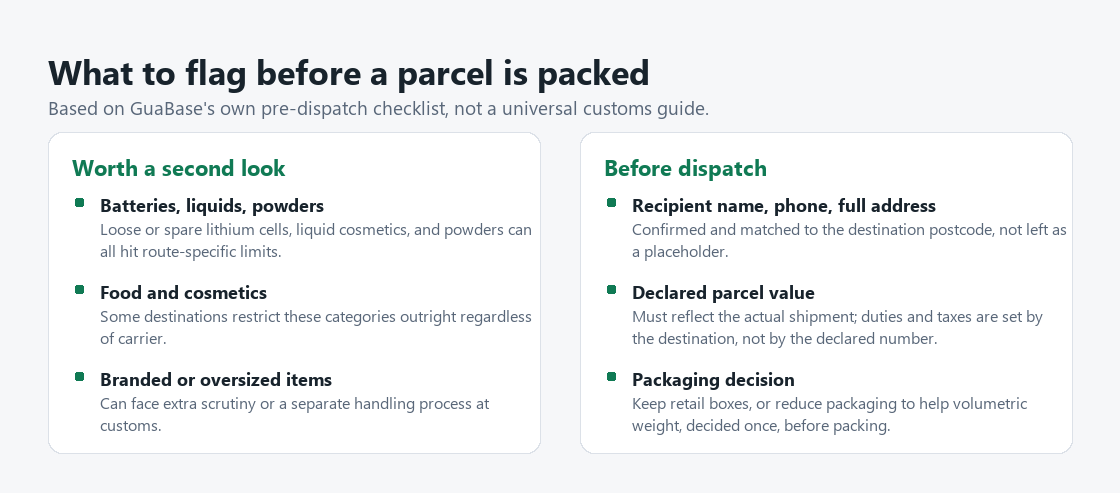
GuaBase's own buying guide lists a short set of things worth checking before international dispatch rather than after, because fixing any of them gets harder once a parcel has already left the warehouse. None of this is a legal customs reference for every destination, it is the specific list GuaBase itself publishes.
On the restricted-category side, GuaBase names seven categories most likely to run into a route-specific limit: batteries, liquids, powders, food, cosmetics, branded goods, and oversized items. None of these are automatically refused, but none of them should be assumed fine by default either, a quick check against the shipping line's own rules before an order is placed avoids a parcel getting stuck later.
On the paperwork side, three things are worth confirming before a parcel is packed: the recipient's name, phone number, and full street address, including postcode, since a change after dispatch depends entirely on the carrier's own policy and may carry its own fee; the declared parcel value, which customs declarations must reflect accurately, duties and taxes are set by the destination authority regardless of what is written down; and a packaging decision made once, whether keeping original retail boxes matters more than reducing bulk to help a volumetric-weight calculation.