
Breaking down the service fee and exchange rate
The service fee, the exchange rate, and chargeable weight are the three numbers behind most of a GuaBase total. All three are sourced below, with a calculator for the first and third.
What the service fee covers

GuaBase charges one purchasing service fee per order, pegged at 5% of item cost and floored at CNY ¥15. It is calculated on item cost alone, domestic shipping, international shipping, payment-processing charges, duties, and carrier surcharges are all shown and charged separately. GuaBase states plainly that it adds no markup on top of the item prices shown in its own purchasing system.
The CNY ¥15 minimum matters more often than the 5% headline rate suggests: on an item under CNY ¥300, the flat minimum is what actually applies, not the percentage. GuaBase's own worked example makes the same point, on a combined CNY ¥238 of item cost across two products, 5% comes to CNY ¥11.90, so the CNY ¥15 minimum is what gets charged.
Two things can make the price shown on GuaBase differ slightly from a listing viewed directly on Taobao or Tmall, and neither is a markup. Marketplace flash-sale, member, regional, or coupon pricing can be specific to an account GuaBase does not have logged in, and the final item cost is only confirmed at the moment of purchase, not at the moment it was first searched. Neither of these changes the fee calculation itself; the service fee still applies to whatever the confirmed item cost turns out to be.
Payment-processing charges sit outside this fee entirely. GuaBase does not layer a charge of its own on top of what Stripe already costs to process a card; a card issuer or bank can still apply one, particularly on an international card transaction settled in a currency other than the card's home currency. That charge, if any, will not appear as a GuaBase line item because GuaBase genuinely does not control it.
Working out chargeable weight before you ship
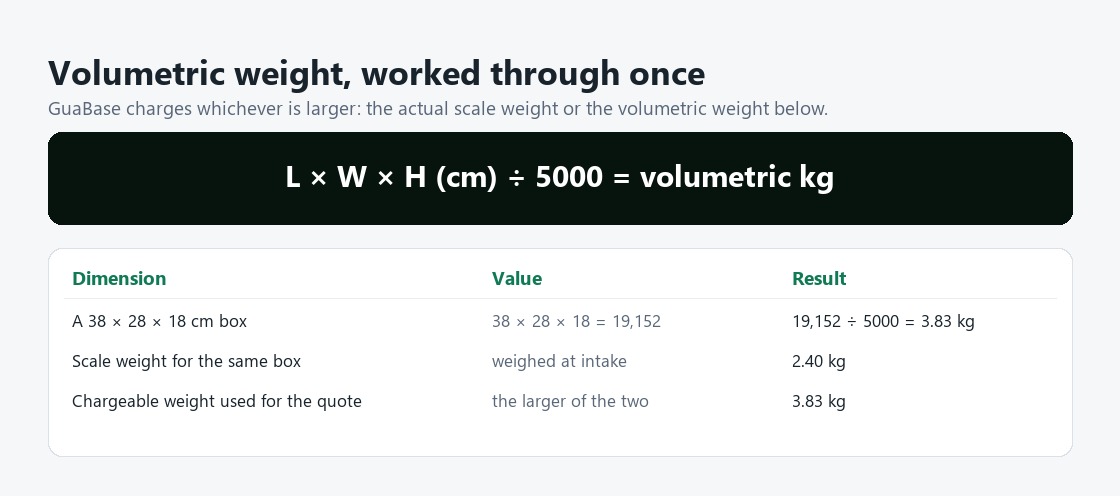
International shipping is priced against chargeable weight, not the number on a bathroom scale. Chargeable weight is whichever is larger: the parcel's actual weight, or its volumetric weight, calculated from its outer dimensions. GuaBase's own example pairing, pillows and plushies billed by volume, books and electronics billed by scale weight, is a useful gut check for which side of that comparison a given item tends to land on.
The worked box below uses its own numbers rather than repeating a figure from elsewhere on this site: a 38 × 28 × 18 cm box works out to 3.83 kg volumetric, which would out-weigh a 2.40 kg scale reading for the same box and set the price.
Try it: service fee and chargeable weight
Enter the total item cost for one purchase order in CNY, plus the packed carton’s centimetres and kilograms. Press Calculate to see the service fee and weight comparison. For a hypothetical CNY 238 order, the fee is CNY 15 and the displayed item-plus-fee subtotal is CNY 253; domestic postage is still separate. The calculator’s weight result is kilograms, not a freight charge.
The exchange rate GuaBase quotes
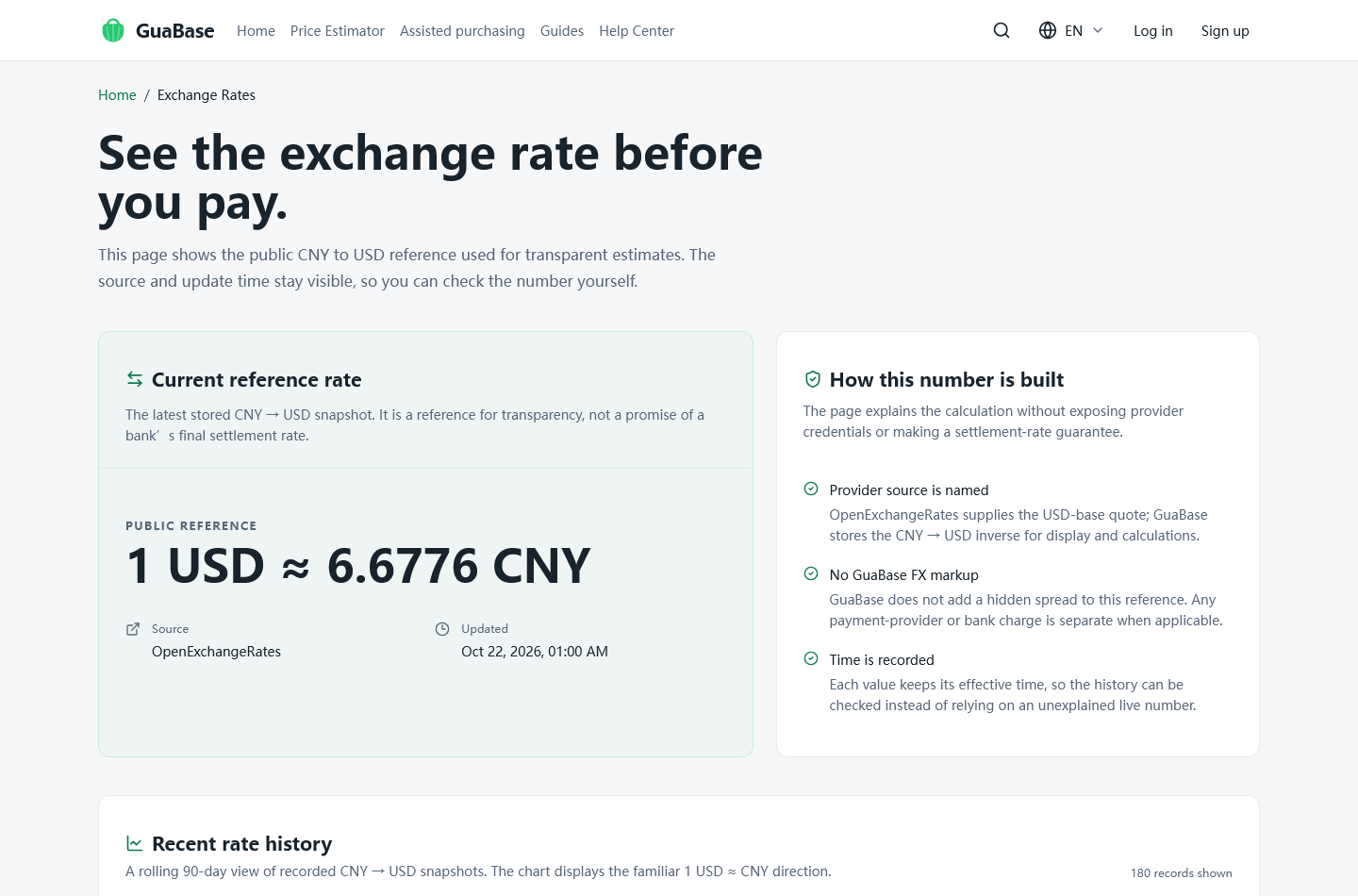
GuaBase publishes a running CNY to USD reference rate, sourced from OpenExchangeRates and stored on an hourly snapshot. As of the 11:00 PM snapshot on October 21, 2026, the published reference was 1 USD ≈ 6.6767 CNY; the page keeps a rolling 90-day history so the number can be checked rather than taken on faith.
GuaBase states it adds no spread on top of that reference. Where a difference still shows up is downstream: Stripe's own Adaptive Pricing can display a different local-currency figure at checkout, and a card issuer or bank can apply its own conversion charge on either leg of the two-stage payment.
The hourly history is worth actually opening rather than trusting a single snapshot, since the rate does move within a day: GuaBase's own recent-history table, read October 21, 2026, shows the reference drifting between roughly 6.676 and 6.679 CNY per USD across a single afternoon, a small range, but one that moves a four-figure order by a few cents either way depending on exactly when the second payment lands.
What this reference rate is for, and is not for, is stated directly on GuaBase's own page: it is a transparency tool for planning and checking a cost, not a settlement guarantee. The checkout total and the payment-time snapshot are what actually apply to a given order, not whatever number happened to be showing when you first opened the page.