
Agents beyond GuaBase, briefly surveyed
Not a ranking, this site has not verified another agent's facts to the standard it holds GuaBase to. A map of what tends to differ, and what to ask instead.
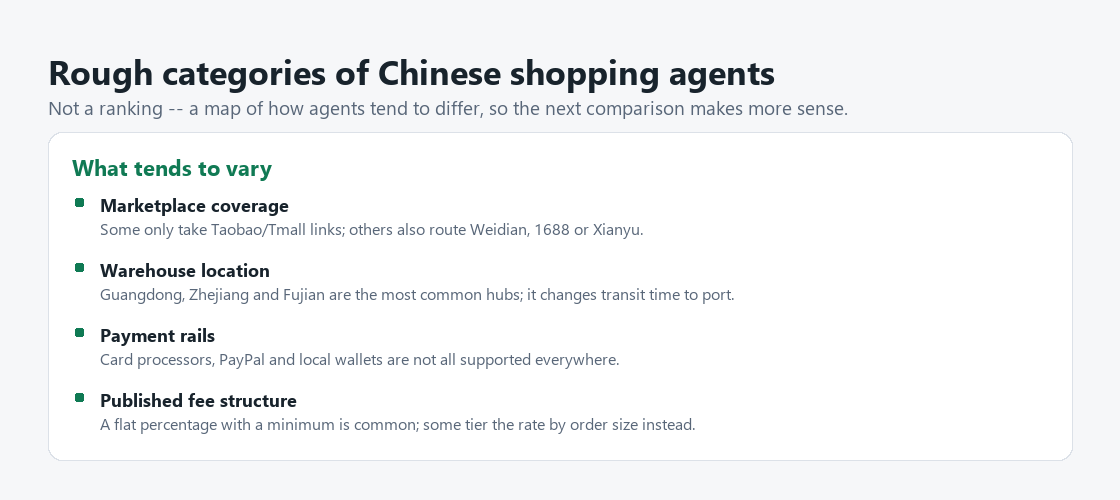
Rough categories of Chinese shopping agents
GuaBase is one of a wide field of services that buy from Chinese marketplaces on a shopper's behalf and forward the result internationally. This page is not a comparison or a ranking of named competitors, this site has not independently verified another agent's fee structure, warehouse location, or refund policy to the standard the rest of this site holds GuaBase to, so it would be guessing to publish one.
What is useful without that verification is the shape of the field: a few dimensions tend to separate one agent from another, and knowing what to ask about narrows a search faster than a name-by-name list would.
Marketplace coverage is the first and most practical dimension. Most agents start with Taobao and Tmall, the two largest domestic marketplaces, but differ on whether they also route Weidian storefronts, 1688 wholesale listings, or Xianyu secondhand goods, and on whether that coverage is an automatic search or a manual request like GuaBase's own assisted purchasing.
Warehouse location is the second, and it is worth checking against an agent's own tracking examples rather than just its marketing copy. GuaBase itself is a useful illustration of why: its real warehouse is in Anji, Zhejiang, per its live shipping-calculator data, while a separate demo tracking timeline on its own help page shows an illustrative example starting from a different city. A mismatch like that is not necessarily dishonest, but it is a reason to check the live data rather than a sample screenshot.
Payment rails are the third. Card processors such as Stripe are common, but not every agent supports the same mix of PayPal, regional wallets, or local bank transfer, and that can matter more than the headline fee rate if a preferred payment method simply is not accepted.
Published fee structure is the fourth. A flat percentage with a stated minimum, GuaBase's own shape, is simple to reproduce by hand. Some agents instead tier the rate by order size or roll it into a less transparent “service charge” applied at checkout with no visible formula; neither approach is automatically worse, but only one of them can be checked in advance.
Questions worth asking any agent, GuaBase included
Four questions tend to surface the real differences faster than a feature list: which marketplaces does it actually search, rather than just mention in marketing copy? Where is its warehouse, and does that match what its own tracking examples show? Is the fee structure a flat rate with a minimum, or tiered in a way that changes behaviour on small orders? And what, specifically, does its refund policy say about the stage after international shipping has already happened, since that is where the weakest policies tend to go quiet.
This site applies exactly those four questions to GuaBase across the Fees, Shipping, QC, and After-Sales pages. The same questions, aimed at any other agent, are a reasonable starting point before trusting a listing price alone.
A fifth question worth adding, specific to younger services: how long has the current version of the policy actually been in effect? GuaBase's own Terms of Service, for comparison, took effect August 1, 2026, and its Privacy Policy February 21, 2026, both recent enough that asking “has this policy been tested by a real dispute yet” is a fair question rather than an unfair one.