
Buying safely: judging agents, sellers and listings
Three checkpoints, in the order they actually happen: the agent, the seller, and the listing itself, with the mistakes that tend to show up after an order is already moving.
Marks of an agent worth your trust
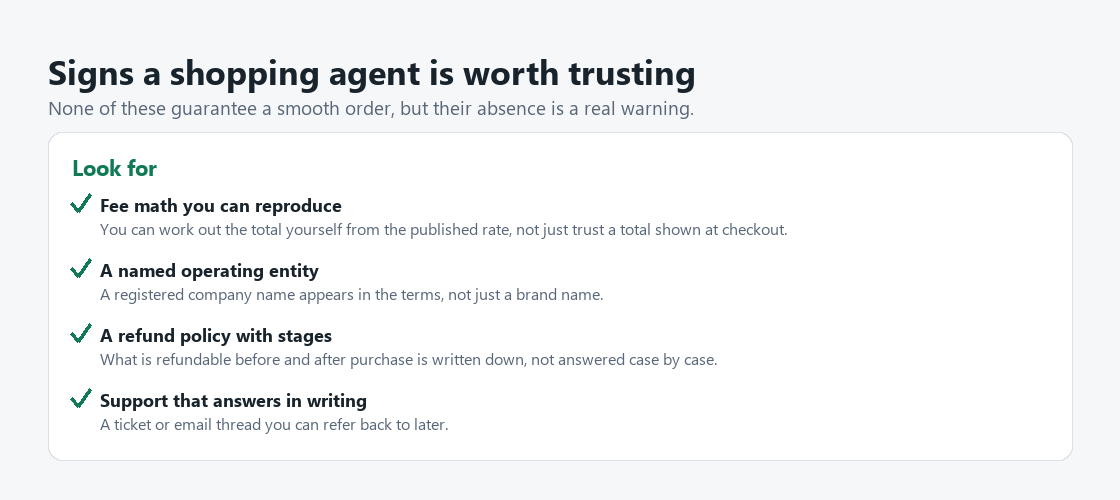
None of the signals below are unique to GuaBase, they are general enough to apply to any shopping agent, and that is the point: a trustworthy agent tends to share a few traits regardless of brand, and their absence is worth noticing before you pay.
A fee you can reproduce yourself is the single most checkable one. If an agent publishes a percentage and a minimum, as GuaBase does at 5% with a CNY ¥15 floor, you can work out the total from the item price alone and compare it against what checkout actually shows. An agent that only reveals a final number at the very end of checkout, with no published rate behind it, has removed the one check you could otherwise do yourself.
A named operating entity in the terms of service is the second. It does not need to be a large company, GuaBase's own structure, a Delaware LLC handling payment with a separate China-side partner handling fulfillment, is a normal shape for this kind of business, but a terms page with no entity name anywhere is a page that nobody is actually accountable to.
The third and fourth signals sit later in an order: a refund policy that is broken into stages rather than answered case by case by whoever happens to be on shift, and a support channel that leaves a written record you can refer back to later, a ticket or an email thread, rather than only a live chat that disappears once the window closes.
How to spot a reliable seller before you send a link
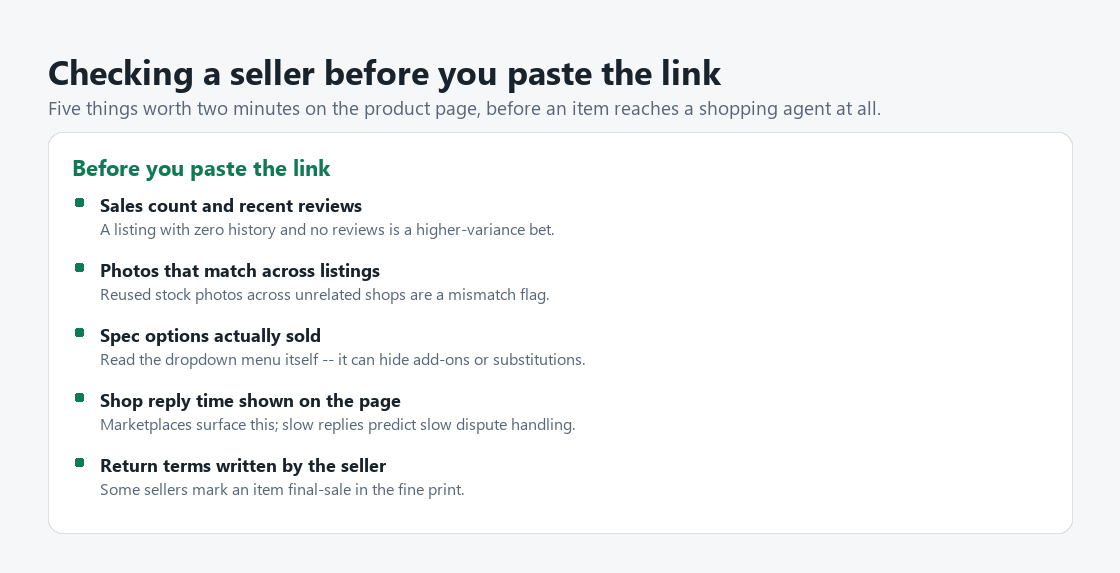
A shopping agent purchases what you point it at; it generally does not pre-screen the seller for you beyond its own basic checks at intake. A few minutes on the listing itself, before it ever reaches an agent, catches more problems than a warehouse inspection can catch afterward, because by the time an item is at a warehouse, it has already been bought.
Sales count and recent review activity are the fastest read. A listing with no sales history and no reviews is not automatically a scam, new listings exist for real products too, but it is a higher-variance bet than one with an established track record, and worth weighing against how replaceable the item is if something goes wrong.
Photos that repeat identically across unrelated shops are a specific and checkable flag: a reverse image search on a listing's main photo, or simply noticing the same exact staged shot on three different storefronts, usually means at least one of them is not the actual manufacturer or an authorised seller of whatever is pictured.
The specification dropdown itself is worth opening rather than trusting the headline image. GuaBase's own buying guide calls this out directly as the most common source of a mismatched order: a low headline price can belong to the cheapest variation in a bundle, not the exact option shown in the photo everyone actually clicks on.
Finally, a seller's stated reply time and their own return terms, both usually visible somewhere on the listing or shop page, are worth reading before paying rather than after a problem shows up. Some sellers mark specific items as final-sale or non-returnable in text that is easy to scroll past.
Picking a listing that survives QC, and the mistakes that follow
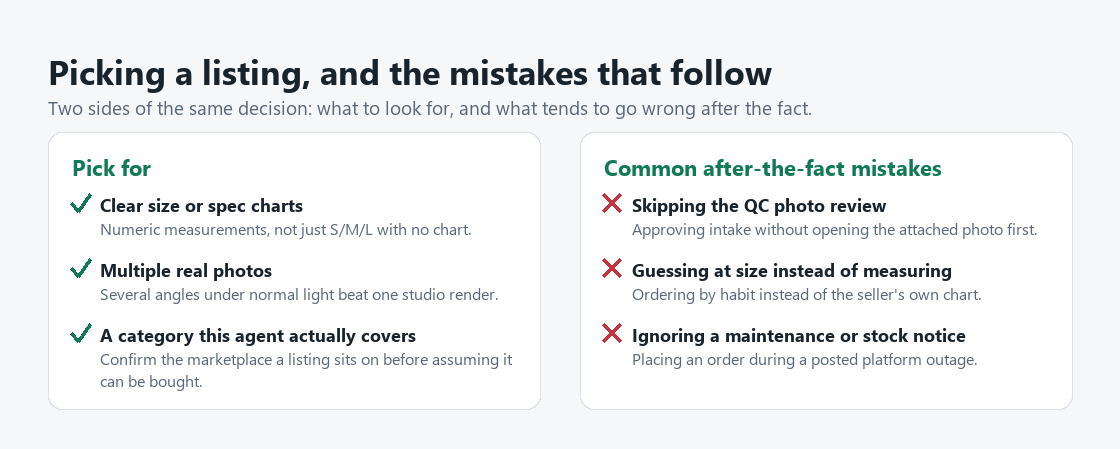
The same decision has two sides worth separating: what makes a listing a safer pick in the first place, and the mistakes that tend to surface only after an order is already moving. GuaBase's own long-form guide calls out two of these directly: assuming the first payment includes international shipping, and choosing a variation from the main listing photo without reading the actual options text.
On the picking side, a size or spec chart with real numbers beats a label of S, M, or L every time, and multiple photos under ordinary light tend to be more honest than one heavily retouched studio render. Confirming a listing actually sits on a marketplace your chosen agent covers, before assuming it can be bought at all, avoids a wasted search request entirely; see the Spreadsheet page on this site for what to do when a find turns out to be on Weidian rather than Taobao or Tmall.
A third mistake worth adding from the Glossary and QC pages on this site: skipping the QC photo review when an item reaches the warehouse. Approving intake without opening an attached photo first removes the one checkpoint that exists before consolidation and shipping make a problem harder to fix, once several items are packed into one parcel, returning a single piece of it is a materially harder conversation than flagging it at intake.
A fourth, specific to the cost side: guessing at a parcel's size instead of using real dimensions in a shipping estimate. GuaBase's own guide flags this directly, ignoring volumetric weight is one of the more common ways a final shipping charge surprises someone who assumed a light item would automatically be a cheap one to ship.
A fifth: ordering during a posted maintenance window or platform outage notice rather than waiting it out. A notice that a marketplace or payment system is temporarily degraded is usually visible on the agent's own announcements page before an order is placed, checking it first costs nothing.