
After-sales: what stays refundable, and how to read a status
GuaBase's refund rules change by stage, not by a single policy. Here is each stage, five real scenarios in GuaBase's own words, and what a problem status actually means.
What stays refundable, by stage
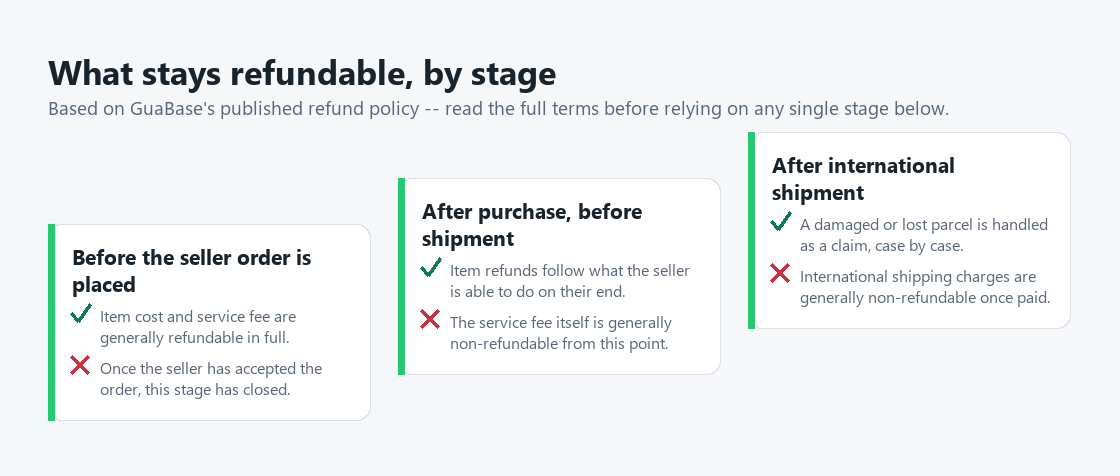
GuaBase does not run one blanket refund policy, it splits an order into three stages and sets a different default for each. Before the seller order is placed, item cost and the service fee are generally fully refundable. After a successful purchase, the service fee becomes generally non-refundable, while the item cost still depends on what the seller is able to do. After a parcel has shipped internationally, that shipping charge itself is generally non-refundable.
“Generally” is GuaBase's own word, not a softening added here, because real cases vary: a seller-side cancellation, a platform restriction, or a QC failure can all shift which default applies. Approved refunds return to the original payment method; GuaBase is explicit that submitting a refund request does not itself pause purchasing or shipping while it is reviewed.
The service fee is the one line that behaves differently from the item cost at the middle stage. Once a seller order has actually been placed, the service fee is treated as earned for the work already done, finding, verifying, and purchasing the item, even if the item itself is later refunded for an unrelated reason such as a seller running out of stock. The item cost in that specific case still tends to come back; the fee for the purchasing step that was actually completed generally does not.
No fixed number of days appears anywhere in GuaBase's refund rules. Eligibility is tied to which of the three stages an order sits in, not to a countdown from the order date, which means the relevant question after a problem shows up is “has the parcel shipped yet”, not “how many days has it been”.
Common scenarios, in GuaBase's own words
GuaBase's Payments & Refunds page lists five scenarios directly rather than leaving them to a general rule. They are reproduced here because the specific wording (“usually refundable”, “depends on carrier policy”) is more useful than a paraphrase.
| Scenario | Typical outcome |
|---|---|
| Item out of stock after payment | The unavailable item's cost is usually refundable; any third-party fee already paid follows that provider's own rules. |
| Quality issue found at warehouse intake | If the return is confirmed as a seller or item issue, the item cost is usually refundable. A personal-preference cancellation at this point follows the seller's own rules instead. |
| Seller changed the item price | GuaBase gives you the choice to cover the new amount or back out. Backing out before purchase keeps the item cost usually refundable. |
| Item cannot legally ship internationally | The order is stopped. If shipping cannot proceed because of a restriction, the item cost is usually refundable. |
| Receiver address needs to change after dispatch | Depends entirely on the carrier's own policy at that point; additional fees may apply. |
Reading an order status that signals trouble
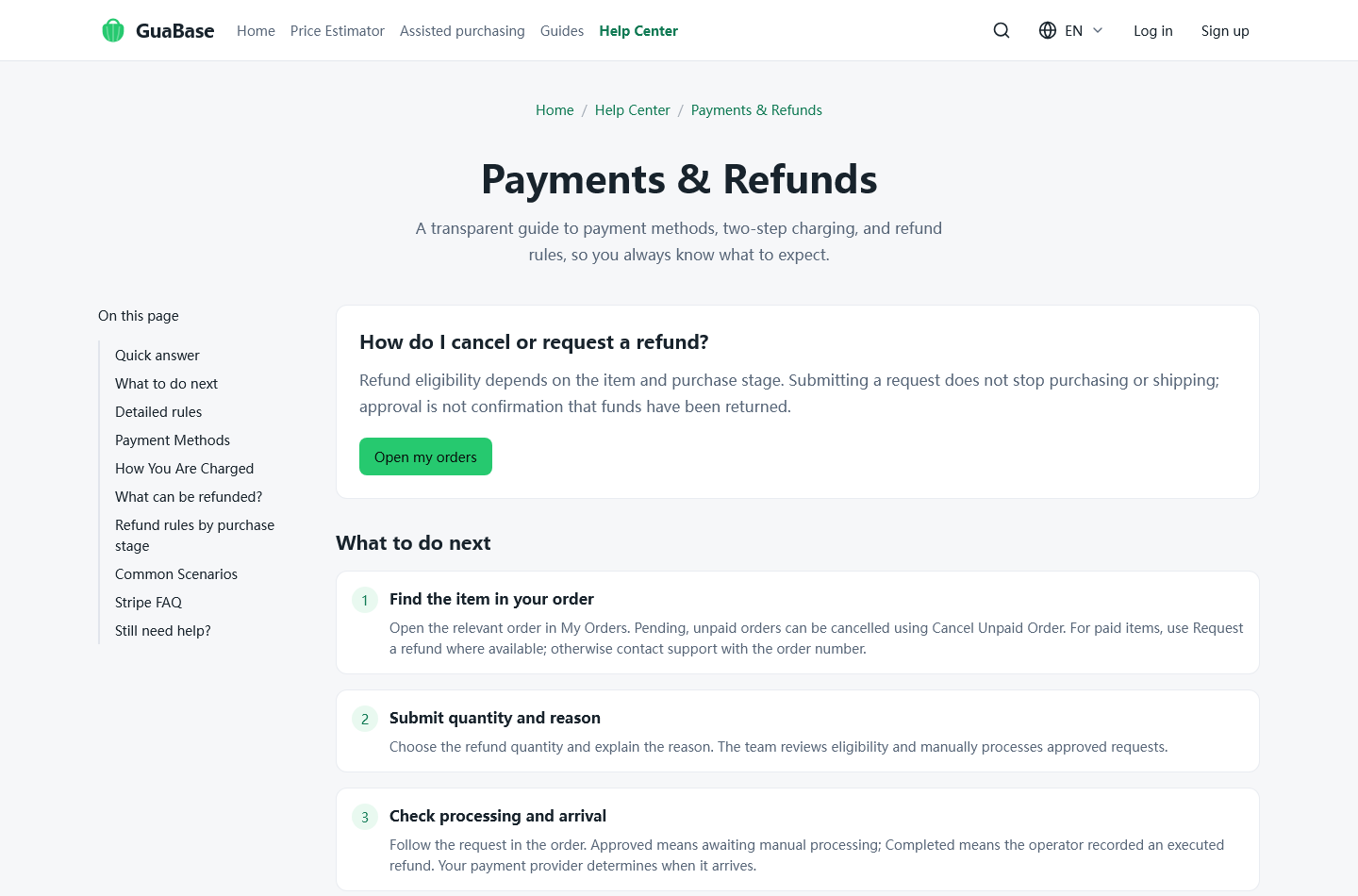
A “Cancelled” order status covers both a shopper-initiated and a seller-initiated cancellation (for example, the seller going out of stock); GuaBase's own guidance is that refunds for this usually return to the original Stripe payment method, with manual review for anything that does not fit that path automatically.
A refund request itself moves through two states worth knowing apart: “Approved” means a human has accepted the request and it is awaiting manual processing, not that funds have moved yet. “Completed” means the operator has recorded an executed refund. From there, how long the money takes to actually land depends on your payment provider, not on GuaBase.
If a QC Failed or Out of Stock status appears on an item, GuaBase's own advice is to contact support with the order number and the specific step you are stuck on, before creating an international parcel around the rest of the order, not after.
GuaBase's own FAQ on this topic adds a specific timing note worth repeating: an order stuck on “Purchasing” with no update for three to five days triggers an automatic internal follow-up on GuaBase's side, so a short delay at that stage is not necessarily a sign of a lost order, but a longer one is worth raising directly rather than waiting indefinitely.
One scenario deserves a slightly longer answer than the table above gives it: changing a receiver's address after a parcel has already shipped. GuaBase's own position is that this depends entirely on the carrier's policy at that point, SF International may or may not support an in-transit address change depending on the route and destination, and any change that is possible can carry its own fee on top of the original shipping charge.